TL;DR
Enterprise B2B events routinely fail to move pipeline because the agenda gets built before the business objective is defined. The Four-Layer Framework designs each curated moment through four questions: What belief shift is required, Why does it matter to the business, How is it executed, and When does it land in the attendee journey. Resolve all four before touching production, and the event is engineered to convert, not just impress.
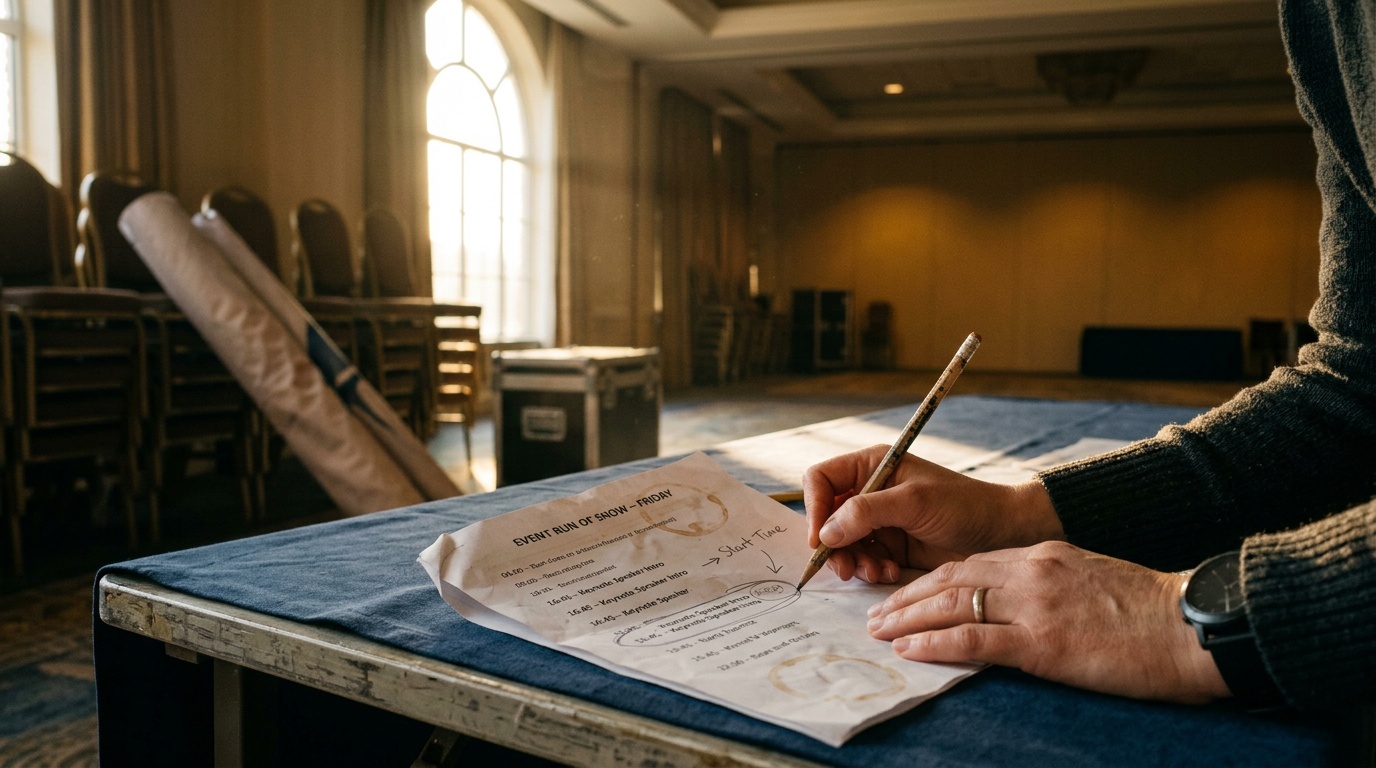
I have reviewed the run-of-show for hundreds of enterprise programs over 15 years in this industry, and the pattern never changes: the agenda is the first document anyone builds, and it is the last one anyone questions. A VP of field marketing emails me the week after a flagship summit. The room was full. The speaker scored well. The CFO still wants to know why the pipeline did not move. I have sat across from that question more times than I can count, and the answer is almost never about production quality. It is about sequence. When the schedule gets built before anyone defines what the attendee needs to believe, feel, or resolve at each stage of the program, the event was never designed to move pipeline in the first place. It was designed to fill a room.
The Design Sequence Problem Behind Every Underperforming Enterprise Event
Conventional enterprise event planning runs on three organizing principles: who is speaking, what the production requires, and how the agenda is sequenced. Each one optimizes for the organizer, not the attendee. Speakers get booked for their title and their credentials, not for the specific belief shift an attendee needs at that point in the journey. Production gets built around venue dependencies and vendor timelines, not around the sensory cues that signal trust or urgency. The agenda gets sequenced for pacing and variety, not for whether an attendee is ready to make a decision.
None of this is a resourcing problem. I have watched well-funded, beautifully produced programs for Fortune 500 clients underperform on pipeline for the same reason every time: the business objective shows up at the end of planning, buried in a measurement deck, instead of at the start, where it should constrain every design decision that follows. That inversion, not the production budget, is what determines whether an event converts.
What Audience-Centered Experience Design Actually Means
Audience-centered experience design is the practice of using the attendee's journey arc, their emotional state, information load, and decision readiness at each stage of a program, as the primary design canvas. It works by replacing the run-of-show with a journey map as the document that generates every subsequent decision.
This is not UX design, which maps digital product interactions. It is not customer experience management, which governs a full lifecycle relationship. It is not event production, which executes a plan but does not set its terms. Production is an execution layer. Audience-centered design is the discipline that decides what gets executed and why.
The unit of this discipline is what I call a curated moment: a discrete, intentionally engineered point in the attendee journey where a specific belief shift, trust signal, or decision gate gets created through the deliberate combination of content, environment, facilitation, and timing. A curated moment is not a highlight reel clip. It is a designed output with a named business objective attached, and if it cannot name that objective, it does not belong in the program.
The Four-Layer Framework: What, Why, How, and When
Every curated moment in my programs gets built against four questions, resolved in this order, before a single production decision gets made.
- What: Name the specific belief shift, trust signal, or decision gate this moment needs to create. Not a session title. A cognitive or emotional state the attendee has to reach.
- Why: Map that moment to a discrete business objective with a measurable output: a pipeline signal, an account qualification, an advanced executive relationship.
- How: Specify the execution mechanism in concrete terms: room configuration, facilitation format, content sequencing, the sensory cue that signals what this moment is for.
- When: Place the moment inside the attendee journey arc, choosing from six stages: pre-event anticipation, arrival and orientation, content immersion, peer engagement, decision moments, or post-event momentum.
This is the Four-Layer Framework, and the discipline that makes it work is sequence. No production decision gets made until all four layers are resolved for the moment being designed. Conventional planning decides How first and treats Why and When as afterthoughts, if it considers them at all. The agenda is an output of the journey map. It is never the input.
How Do You Map the Attendee Journey Before You Build the Agenda?
Map the attendee journey by walking through six stages before writing a single agenda line: pre-event anticipation, arrival and orientation, content immersion, peer engagement, decision moments, and post-event momentum. At each stage, name the attendee's dominant unresolved question, then design only the three to five moments where that question is most movable.
Most programs get this backward. Pre-event anticipation becomes a logistics email about venue and schedule instead of building the belief that attending is worth the time. Arrival and orientation gets consumed by badge pickup instead of a first impression that signals intent. Content immersion defaults to back-to-back sessions that maximize information delivery and minimize the reflection peer engagement requires. Decision moments, the most commercially valuable stage in the entire journey, get left to a follow-up call that arrives after the momentum is gone.
Design the moment before you book the room. The room speaks before you do.
Aligning Every Moment to a Business Objective Without Turning the Room Into a Sales Pitch
Every VP of field marketing I work with is under pressure to prove pipeline attribution, and every attendee disengages the moment a program feels transactional. Most teams resolve this by sequencing design and measurement separately: design the experience first, then try to bolt business tracking on after the fact. That sequence is the problem. When a business objective gets appended to an experience that was never designed to produce it, the resulting signal is weak and the attribution gets contested in the next budget review, whether or not the attendee actually felt the pressure.
Audience-centered design resolves this structurally. When the Why layer gets resolved before the How layer, the business objective is embedded in the moment's design, not bolted on afterward. An executive roundtable built to advance a named account relationship, with the right room configuration, the right facilitation question, the right peer composition, produces a qualified pipeline signal as a byproduct of genuine engagement. This is the operating premise behind our Event-Led Growth capability: capture the intent and momentum a program already generates, rather than manufacturing it separately. Craft with a target. Every moment maps to a business objective, or it gets cut.
Where This Comes From: Fifteen Years of Watching the Pattern Repeat
I built this framework out of necessity, not theory. Fifteen-plus years running experiential programs for Fortune 500 companies taught me that the agencies attendees remember are not the ones with the biggest production budget. They are the ones where every moment felt intentional. At Sandbox-XM, our focus is the full attendee journey: turning complex programs into curated moments where guests feel taken care of, not just informed. That is not a tagline. It is the operating sequence behind every program we design, delivered with clarity, care, and execution discipline.
The Four-Layer Framework is how we apply that focus without the overhead of a traditional agency. Experience Strategy defines the what, why, and how before execution begins. Operations and Delivery executes with calm, predictable sequencing so the experience feels seamless to the guest. Event Technology and Measurement captures the signals that matter and translates them into next-step action, rather than a vanity dashboard. None of this works if the business objective arrives after the design is locked. It has to be the first constraint, not the last report.
What to Do Before the Next Program Is Booked
If you are planning your next enterprise program, do not start with the agenda. Start with four questions: What belief shift does this account need before they will move? Why does that belief shift matter to a deal already in motion? How will the room, the facilitation, and the sequencing make that belief shift happen? When in the journey does it land? Resolve those four layers for the three to five moments that matter most in the program, then let the agenda follow.
If you are the one defending the budget in the next planning cycle, this is the sequence that gives you something more credible than a satisfaction score to bring to that conversation: a named moment, a named business objective, and a signal you can trace into the CRM.
I am happy to walk through what that looks like for your next program.
Frequently asked questions
What is audience-centered experience design?
Audience-centered experience design is the practice of using the attendee's journey arc, their emotional state, information load, and decision readiness at each stage, as the primary design canvas for an event. It works by replacing the run-of-show with a journey map as the document that generates every subsequent decision. It is distinct from UX design, customer experience management, and event production, each of which operates at a different layer.
What is the Four-Layer Framework for event design?
The Four-Layer Framework resolves four questions for every curated moment before any production decision is made: What belief shift, trust signal, or decision gate the moment needs to create; Why it maps to a measurable business objective; How it gets executed in concrete terms; and When it lands within the six-stage attendee journey. No production decision is made until all four layers are resolved. The agenda is an output of this process, never the input.
What is a curated moment in event design?
A curated moment is a discrete, intentionally engineered point in the attendee journey where a specific belief shift, trust signal, or decision gate is created through the deliberate combination of content, environment, facilitation, and timing. It is not a generic highlight; it is a designed output with a named business objective attached. If a moment cannot name that objective, it does not belong in the program.
How do you map the attendee journey before building an event agenda?
Map the journey by walking through six stages before writing a single agenda line: pre-event anticipation, arrival and orientation, content immersion, peer engagement, decision moments, and post-event momentum. At each stage, identify the attendee's dominant unresolved question, then concentrate design investment on the three to five moments where that question is most movable rather than trying to redesign the entire program.
How does audience-centered design tie event experience to pipeline without making the event feel like a sales pitch?
It resolves the business objective at the design stage rather than appending it afterward. When the Why layer is resolved before the How layer, a moment like an executive roundtable gets built with the right room configuration, facilitation question, and peer composition to advance a specific account relationship, and the qualified pipeline signal becomes a byproduct of genuine engagement rather than a bolted-on tracking layer.
When should event technology be selected in the design process?
Technology should be selected after the experience design is locked, not before. Each technology component should be evaluated against a single criterion: does it serve a specific layer of the Four-Layer Framework for a specific stage of the attendee journey? If a tool cannot be mapped to a What, Why, How, and When, it does not belong in the program stack.
Ready to turn your next event into a pipeline-generating program? Talk to Sandbox-XM.